Amazon Pricing Push Readiness
Lists every active Amazon Product Pricing record together with the validation problems that would block it from being pushed — a pre-flight gate so you fix data before a feed goes out.
Screenshot
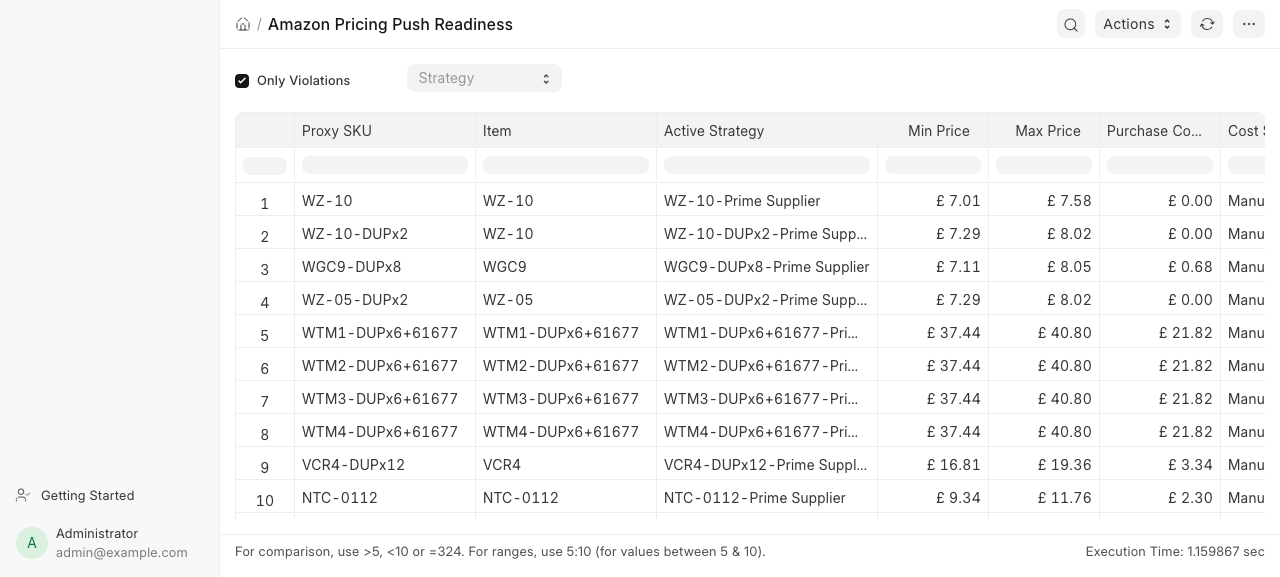
Purpose
- Pricing users verifying SKUs are safe to push before submitting a feed.
- Answers: which active pricings have a broken strategy, a zero/negative price, a below-cost floor, or a price move that exceeds the deviation guard?
- Defaults to showing only rows with violations so a clean list means "ready to push".
- Quantifies the below-cost leak risk the hard money floor is designed to catch.
How to Access
Desk > Reports > Amazon Pricing Push Readiness, or /app/query-report/Amazon Pricing Push Readiness.
Report type: Script Report. Reference DocType: Amazon Product Pricing.
Filters
| Filter | Type | Required | Description |
|---|---|---|---|
| Only Violations | Check | No | Default 1 (on). When checked, rows with no violations are hidden. |
| Strategy | Select | No | fba / sfp / backorder / default. Matches against the active strategy's strategy_name. |
Columns
| Column | Type | Description |
|---|---|---|
| Proxy SKU | Link → Proxy SKU | The pricing record's Proxy SKU. |
| Item | Link → Item | The Item behind the Proxy SKU. |
| Active Strategy | Link → Amazon Product Strategy | The currently selected strategy on the pricing (active_strategy). |
| Min Price | Currency | current_min_price on the pricing. |
| Max Price | Currency | current_max_price on the pricing. |
| Purchase Cost | Currency | value of the active (rank 1) purchase-cost row on the active strategy. |
| Cost Source | Data | source of that purchase-cost row (e.g. Manual, Supplier-Sync, PO-Sync, FBA-Transfer). |
| Violations | Data | Semicolon-joined list of all blocking reasons. Rendered bold red when present. |
How It Works
Only Amazon Product Pricing rows with is_active = 1 are scanned. For each, collect_pricing_violations() runs the same guard logic the feed submitter uses, so the report mirrors exactly what would block a push.
flowchart TD
  A[Active Amazon Product Pricing] --> B{Active strategy?}
  B -->|missing / not found / disabled| V1[strategy violation]
  B -->|ok| C{Purchase cost row}
  C -->|none| V2[no purchase cost row]
  C -->|value <= 0| V3[purchase cost <= 0]
  C -->|value > 0| D[checks]
  D --> E{min/max sane?}
  E -->|min<=0 or max<=0| V4[zero/negative price]
  E -->|min>max| V5[min above max]
  E -->|min==max, no fixed_price| V6[min equals max]
  D --> F{min <= purchase cost?}
  F -->|yes| V7[at/below cost floor]
  D --> G[price deviation guard]
  G -->|move > threshold %| V8[deviation block]
  V1 & V2 & V3 & V4 & V5 & V6 & V7 & V8 --> OUT[Violations cell]
Violation rules (verbatim from pricing_validators.collect_pricing_violations):
No active strategy— pricing has noactive_strategy.Active strategy {name} does not exist/... is disabled— strategy missing oris_active = 0.No active purchase cost row on the active strategy— no rank-1 purchase-cost row found.Purchase cost is {value} (source: {source})— purchase cost is<= 0.Min price is {value}/Max price is {value}— price<= 0.Min price {min} is above max price {max}— inverted band.Min price equals max price without a fixed price—min == maxandfixed_pricenot set.- Hard money floor:
Min price {min} is at or below purchase cost {cost}— blocks a below-cost leak for that single SKU whenmin_price <= purchase_cost. - Deviation guard:
Price {drop|rise} {pct}% exceeds threshold {threshold}%— frompartition_pricing_by_price_deviation, comparing the new min/max band against the Proxy SKU'scurrent_selling_price. The threshold is theprice_change_threshold_percentfield in Navgold Settings, and direction is gated byprice_change_block_direction(Both/Drops Only/Increases Only). A blank current selling price yieldsNo current selling price.
Conditional formatting (from the report JS)
- Violations cell is rendered bold red (
--red-500,font-weight: 600) whenever it is non-empty.
Notes
- With Only Violations on (the default), an empty report means every active pricing is push-ready.
- The deviation check is identical to the live feed guard, so a row blocked here would also be blocked at submission time.
- Related: Amazon Purchase Cost Overview (fix the cost source feeding the floor) and Amazon Pricing Push Monitor (what happened after you pushed).
Last updated 1 month ago
Was this helpful?